Boston Celtics 2025–26 Season
Boston Celtics 2025–26 Season
Analytics-Driven Coaching Strategy
Analytics-Driven Coaching Strategy
Overview
The Boston Celtics enter the 2025–26 season facing a significant roster transition. In this project, I developed a data-driven coaching and roster strategy for the Boston Celtics' projected 2025–2026 season. The objective was to evaluate team performance metrics, analyze individual player impact, and recommend optimal lineup combinations that could maximize team efficiency and win probability.
Using per-100 possession stats, advanced metrics, Four Factors analysis, and real lineup net rating data, this report identifies the team's strengths and vulnerabilities, and delivers a concrete rotation framework with game-specific strategic adjustments to support coaching decisions, roster management, and game strategy.
View R Script on my Github.
Business Problem
The 2024–25 Celtics were one of the most efficient offenses in the league. The 2025–26 roster looks fundamentally different. Tatum was the primary scorer and anchor of the team's offensive system. Holiday and Porziņģis provided two-way value that is difficult to replace in a single offseason. Horford and Kornet gave the team experienced, switchable bigs who protected the rim and kept the defense organized.
Key Question:
How can Boston maintain efficiency, defensive identity, and lineup stability through a major roster transition?
Team Baseline: Four Factors Analysis
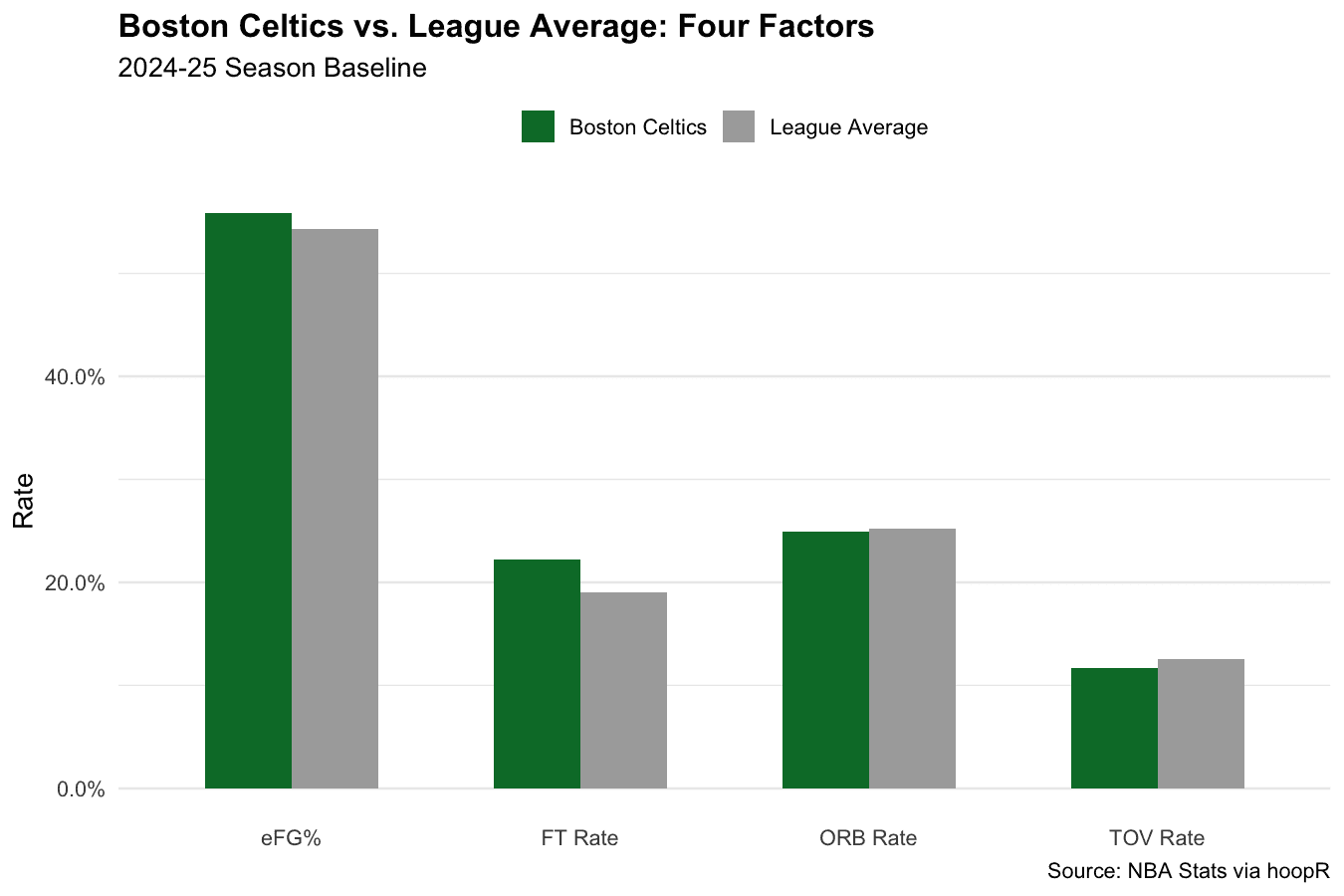
The Four Factors framework covers effective field goal percentage, turnover rate, offensive rebounding rate, and free throw rate. Together they provide the clearest picture of where Boston excelled and where it was exposed.
Offensively
The Celtics shot more efficiently than the league average and protected the ball exceptionally well, finishing below the league average in turnovers. Their offensive rebounding rate was roughly league average, and their free throw rate lagged behind, a minor weakness that becomes more significant without Tatum drawing fouls as a primary creator.
Defensively
Boston held opponents to below-average shooting efficiency and did an excellent job on the defensive glass. The one area of concern was forcing turnovers, where the team finished slightly below average, a factor that becomes more meaningful without Holiday's defensive impact.
Player Performance Analysis
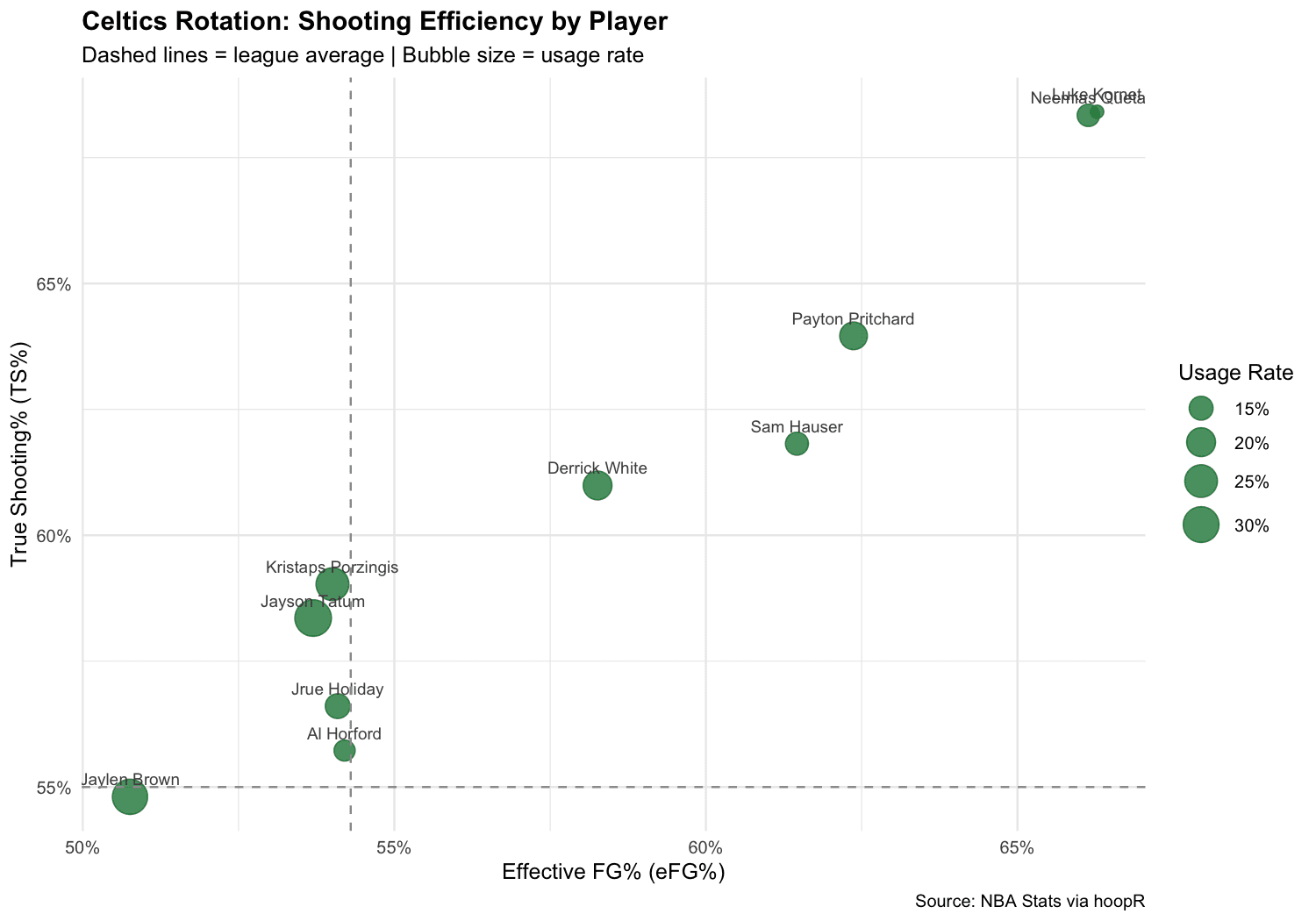
The projected rotation depends on role balance. White anchors the two-way identity, Brown becomes the primary scorer, and Pritchard, Hauser, and Simons provide spacing and shot creation. In the frontcourt, Queta’s efficiency and Garza’s rebounding become key to protecting Boston’s interior production.
Lineup Optimization
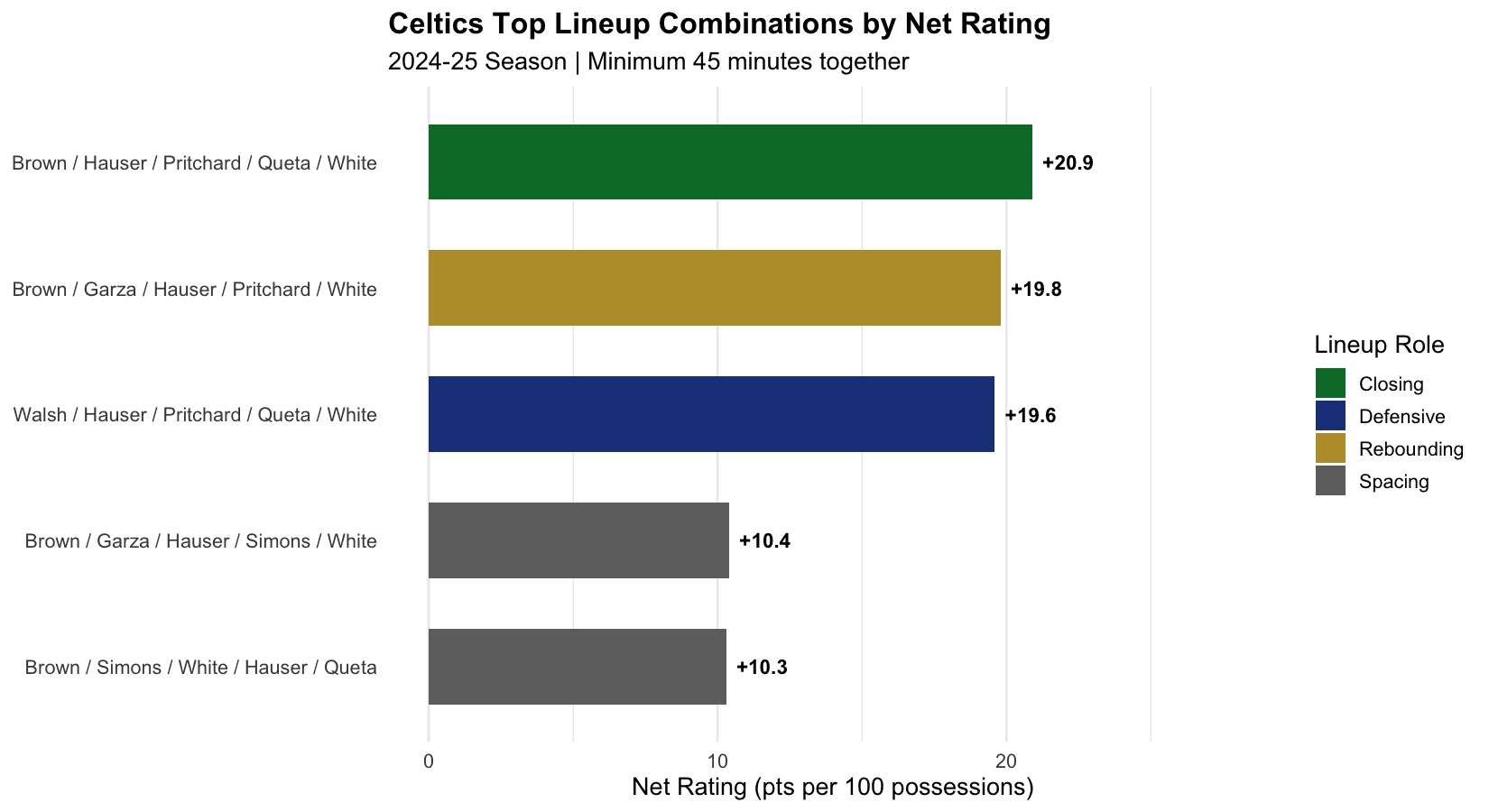
Lineup net rating data tracks how the team performs per 100 possessions with specific five-man units on the floor and is the most direct way to evaluate rotation decisions. The analysis uses lineups with a minimum of 45 minutes together.The strongest lineup combination is Brown, Hauser, Pritchard, Queta, and White, with a +20.9 net rating. Boston is most effective when spacing is paired with at least one strong rebounder.
Game Specific Adjustments
Vs. Big / Physical Teams
Boston should prioritize size, rebounding, and interior positioning against physical teams. Garza and Queta become critical in these matchups, while Walsh can absorb tougher wing assignments to keep White available as the primary perimeter defender.
Vs. High-Pace Transition Teams
Against faster teams, the priority is controlling pace and limiting transition opportunities. Boston should emphasize defensive rebounding and disciplined floor balance.
Vs. Elite Perimeter Shooting Teams
Against more perimeter shooting teams, Boston should lean on Walsh’s defensive versatility and use selective zone looks to disrupt rhythm. Offensively, Brown and Queta can attack inside the paint paint and force defensive adjustments.
My Coaching & Roster Recommendation
The 2025–26 roster still has the pieces needed to remain one of the top teams in the league. The single biggest structural issue this roster faces is interior rebounding. The team lost two of its best rebounders. Garza and Queta must rotate so at least one elite rebounder is always on the floor. Second-chance points are the team's highest-leverage source of extra possessions and the clearest path to compensating for Tatum's absence.